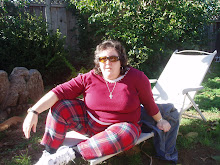
Grad Council weekend
April 7-9, 2011, Guiding Eyes for the Blind, Yorktown Heights, New York
We left White Plains at 1 pm Thursday afternoon, arriving at Guiding Eyes around 1:45, just in time for lunch, grilled cheese and tomato soup. After dropping off our bags, Ro and I walked over to the Kennel for her annual vet visit. We reunited with Lily, the clinic’s resident kitty, who loves Ro. Unfortunately, Ro’s experience wasn’t routine. The growth on her nose was biopsied, and once her lyme and borditella vaccinations were given, she was subjected to an intense ear cleaning due to ear gunk. Once the vet determined it was yeast, Ro was given an anti-inflammatory injection, ear drops, and we were loaded up with various treatments and sent on our way.
While in our room, Ro apparently decided to christen the bed, so we had to move to another room. How embarrassing. I kept her off the bed and on the tie-down the rest of the night, sensing she was overwhelmed and was just not herself.
After the reception dinner, I let her run off some energy in Alumni hall, then put her back on tie-down in the room and hung out for a while with the other grad council members. When I returned later, she had regurgitated her dinner and the water she drank, and I spent 20 minutes mopping it up.
Friday morning she was fine and we spent the day in meetings, followed by a group run in the planet dog yard and a kennel tour.
Clicker training was at the end of the day, a fun obedience task for Verona and she was smiling as we took part in it. We also were shown the new prototype harness and I must say it is like a Coach product for dogs. Rich, sturdy harness leather and solid brass hardware, updated and classic. I can’t wait to get one.
Friday night we hung out and let the dogs play while we talked and laughed, shared the stuff that makes us a family. At one point, Verona and Tanya, a yellow labbie, went up to the second floor to explore the offices and neither Dick or I could persuade them to come back. We ended up calling them for five minutes until finally, they sauntered back down the stairs, pretending to ignore our anxiety that neither of them came when called.
We all had a good laugh with that. Then another grad was furminating his dog, getting the hair on his beard and face. The instructor who was hanging with us dust busted his face, which sent us all roaring with laughter, as we all know how dog hair gets into everything, including beards. Another grad played hide and seek with his dog.
What really helped me the most was the candid conversations with other blind people, sharing what others cannot unless they, too, live with blindness. We laughed over having “retinal farts” and eye spasms, fearing the dark, sunlight, and new places. We shared our aspirations for our careers, family, and health concerns. It was one of the most enriching times I’ve ever known and I will treasure it for the rest of my life.
The night walk was the most exhilarating part of this for one reason: I am scared of the dark because I’m a total at night. No visual information, just twinkling lights on a terrible, velvet curtain; no top, bottom, left, or right, Darkness in a bubble.
I wouldn’t let anyone else know how scared I was and when an instructor offered to take us out, I jumped at the chance. There was a moment when I thought, are you nuts? The anxiety tightened my chest so much I had to use my rescue inhaler, but I refused to opt out. I had to do this no matter how hard it was;this is the last barrier for me.
I set off with five others, was proud of my little Verona, she guided me without incident and I came back knowing the dark was no longer the fear it had once been.
So, what did grad council do for m I’m not sure I can adequately state what I’m feeling right now, as I write this – but I do know that I am stronger, more confident, better able to accept all that life rolls out for me because I have the companion who helps me make sense of the sighted world.I also now know I also have the comraderie and understanding of others like me.
Sunday, April 10, 2011


Friday, April 1, 2011
not finishing stories
I've been beating myself up about not finishing my stories. Apparently it is a bad habit beginning with growing up with a dysfunctional family, at least according to the family therapy experts. I didn't learn the skills to plan and complete basic tasks, which has influenced my laxity about not wrapping things up and knowing how satisfied it is doing so. It all has to do with the lack of self-confidence and low self-esteem. {insert heavy sigh} So, being who I am, I'm working on righting the wrongs by revisiting all the half-finished, almost done stories I've written so far. I'm kind of alarmed to admit there are a lot of them. So, here I am, blogging about it. Feeling guilty about it. Not knowing why it happened or how to fix it.
The thing is, that I do finish what I begin in other areas of my life. I have completed other stories, many poems, and a gazillion other tasks, so what's the deal here?
I'm not sure but knowing the problem leads to finding a solution. Maybe I just need to stick with one thing at a time. Creatively speaking, I am a bit whimsical and improving my focus will get me to accomplish more that I've been. Right? Right.
See you on the pages, then.
The thing is, that I do finish what I begin in other areas of my life. I have completed other stories, many poems, and a gazillion other tasks, so what's the deal here?
I'm not sure but knowing the problem leads to finding a solution. Maybe I just need to stick with one thing at a time. Creatively speaking, I am a bit whimsical and improving my focus will get me to accomplish more that I've been. Right? Right.
See you on the pages, then.
Monday, March 14, 2011
Birthday Post
Sunday, March 13 has passed and I'm one year older. The year is still young so I don't know how life will be but so far it's acceptable. I have found a great source of support from some folks I've been working with both at the job and my volunteer positions. I'm very excited about it. I can sometimes be so focused on tasks that I forget to just have fun, go out with friends and be social. I think this is the biggest and best change for me since getting Verona.
I began writing a memoir and will post excerpts herein when it's ready for other eyes and ears. Smile.
Until next time --
I began writing a memoir and will post excerpts herein when it's ready for other eyes and ears. Smile.
Until next time --
Friday, February 25, 2011
Dream or the Power of Suggestion?
Have you ever had a dream that is not what it seems? What I mean is, I woke up this morning remembering a dream with a recurring character, my husband’s best friend. His name was Joe and he died at the age of 38 from congestive heart failure. Whenever he appears in my dreams, the first thing he says is that he’s sorry he hasn’t visited me for so long but that he was busy. That’s pretty much what he’d say after disappearing for a long time and popping up just when we gave up hope of ever seeing or hearing from him again. Then he would call or ring the bell. That’s how he enters my dreams.
This time he took me for a tour. The house was similar to his parents’ home except much larger. It also looked out on Long Island Sound. I remember standing with him, feeling the sun and hearing the gulls overhead in the distance. This time his father was there, making sure the guests were well fed and entertained. Joe looked sad and he said he missed us, that he wished things had turned out differently.
He said that it was harder and harder to visit, that this might be the last time, that he had to learn to accept his death and all it implied. I said I understood and when it was time to say goodbye, I kissed him. It felt as real and as satisfying as if I really did it. I told him that if he didn’t visit anymore that at least I could give him a gift he’d remember. And we both laughed.
I woke up with the conviction that we wouldn’t have another visit and it made me feel sad. Losing Joe was hard for us and neither of us ever thought it would happen. Maybe my mind is reliving the memories as a way of coping with death. A friend’s husband died last week and I heard just yesterday about another woman losing her husband at age 35. Perhaps these two deaths triggered my mind to reconnect with memories of Joe .
Or, maybe, he was just popping in for a psychic visit.
This time he took me for a tour. The house was similar to his parents’ home except much larger. It also looked out on Long Island Sound. I remember standing with him, feeling the sun and hearing the gulls overhead in the distance. This time his father was there, making sure the guests were well fed and entertained. Joe looked sad and he said he missed us, that he wished things had turned out differently.
He said that it was harder and harder to visit, that this might be the last time, that he had to learn to accept his death and all it implied. I said I understood and when it was time to say goodbye, I kissed him. It felt as real and as satisfying as if I really did it. I told him that if he didn’t visit anymore that at least I could give him a gift he’d remember. And we both laughed.
I woke up with the conviction that we wouldn’t have another visit and it made me feel sad. Losing Joe was hard for us and neither of us ever thought it would happen. Maybe my mind is reliving the memories as a way of coping with death. A friend’s husband died last week and I heard just yesterday about another woman losing her husband at age 35. Perhaps these two deaths triggered my mind to reconnect with memories of Joe .
Or, maybe, he was just popping in for a psychic visit.
Monday, February 21, 2011
PTSD POEM
The Keeper
By Ann Chiappetta
You ask me to hold the secrets
Put the stories away
You must think me the mental Equivalent of Fort Knox
Accepting your dark treasure
denser than gold and so heavy you can’t move it.
So heavy even Atlas couldn’t bear it.
Locked up until the next time we meet.
the tales told are soul-stealing
corrosive
Seductive as nails down your back.
I think you stay in those stories,
beCause it’s easier than saying goodbye.
Part of you lives on in them
While within the same stories,
You hold on to the part that died.
December 2010
By Ann Chiappetta
You ask me to hold the secrets
Put the stories away
You must think me the mental Equivalent of Fort Knox
Accepting your dark treasure
denser than gold and so heavy you can’t move it.
So heavy even Atlas couldn’t bear it.
Locked up until the next time we meet.
the tales told are soul-stealing
corrosive
Seductive as nails down your back.
I think you stay in those stories,
beCause it’s easier than saying goodbye.
Part of you lives on in them
While within the same stories,
You hold on to the part that died.
December 2010
Saturday, February 12, 2011
new Dialogue byline
What I want to Remember
By Ann Chiappetta
I lost my sight at the age of 28, and resigned from my job because of it. I worked as a designer for an acrylic furniture company and could no longer perform my job duties, which were all visual in nature. I mourned this part of my life more than any other because I didn’t know how to take all the creative energy and transfer it into something else. One night, out of sheer frustration, I began to write. First it was poetry, most of it fanciful and meaningless. This turned into journaling and short stories, which led to some successful small press literary magazines publishing my work. It wasn’t until much later, when I was in college, that I realized I’d made the transition from expressing myself with the visual arts to those of the literary kind. From this point, I resolved to develop my talent because I knew it would become an essential part of learning how to successfully live with a disability.
What I didn’t realize back then was that re-training my mind was the cornerstone of the transition into blindness. I will always remember what life was like before it and I am grateful that I do have the visual references of the first 26 years of my life to help me go forward.
Images have a way of tattooing themselves to the psyche. If they are referenced enough, one will never forget them. All writers use this sensory recall as an essential tool to enhance the craft. What I didn’t know at the time was that developing it would one day help me deal with losing my sight.
I call this my soul sense, and it incorporates personal visual experiences with other sensory skills, like touch, sound, smell, and taste.
For instance, when I hear a jet plane, my mind cues up the image; when someone points out a beautiful sunset, I recall one. I use the power of observation to keep the memories close, that way I will never be without a reference.
Of course there will be surprises, like when I expected the Napa leather bag to be black or brown and the sales clerk told me it was electric blue. I’d never seen electric blue leather bags, so it took me a moment to put the image and the color together in my mind.
Blindness is a way of being, a distinct circumstance in which a person learns how to navigate through life. To ignore it means we are ignoring ourselves and denying the personal growth to cope with the emotional nature of living without it.
Retinal degeneration has made my world monochromatic. I do, however, remember the colors I can no longer detect. In my mind’s eye, the flat grey and black bushes dotted with stark white blobs are blooming forsythias lining the sidewalk. The vivid yellow flowers and light green leaves under the blue sky are only memories.
Does this sadden me? Frustrate me? It used to but not now. It happened so gradually that I had time to adjust. I already knew what forsythia looked like so for me, even when the color blindness began, the reference guide in my head kept me from feeling like I was missing out on something.
Retinal degeneration has also rendered me night blind. Since I was about ten years old, the lack of any form of light filled me with anxiety. It made me feel so helpless. Now, however, I do my best to face the dark with courage, though I don’t always succeed.
If I could impress just one piece of advice upon a young visually impaired person I would tell them to never give up, learn Braille, mobility skills, and trust themselves to know when to ask for help. I would ask this young person to remember the golden rule of true Independence: know when and how to ask others for help to achieve it. We are, after all, interdependent, learning how and when to ask for assistance will open doors and prevent social isolation.
What I miss seeing the most: faces of those I love. What I don’t miss: the ugliness of suffering and violence.
What advice to I have for someone who is progressing into blindness? Do the best to let your mind file away what you want to remember visually.
If you’ve seen a breathtaking view of the Grand Canyon, even if it was only a photo, when you are actually standing at the rim, it won’t really matter. You will be smelling, tasting, and listening to the majesty of that wondrous place. Your soul sense will aid in the expansion and creation of new memories.
Ask yourself what you want to remember and make it happen.
Explore, ask questions, and refine your skills for those times you will need them most.
By Ann Chiappetta
I lost my sight at the age of 28, and resigned from my job because of it. I worked as a designer for an acrylic furniture company and could no longer perform my job duties, which were all visual in nature. I mourned this part of my life more than any other because I didn’t know how to take all the creative energy and transfer it into something else. One night, out of sheer frustration, I began to write. First it was poetry, most of it fanciful and meaningless. This turned into journaling and short stories, which led to some successful small press literary magazines publishing my work. It wasn’t until much later, when I was in college, that I realized I’d made the transition from expressing myself with the visual arts to those of the literary kind. From this point, I resolved to develop my talent because I knew it would become an essential part of learning how to successfully live with a disability.
What I didn’t realize back then was that re-training my mind was the cornerstone of the transition into blindness. I will always remember what life was like before it and I am grateful that I do have the visual references of the first 26 years of my life to help me go forward.
Images have a way of tattooing themselves to the psyche. If they are referenced enough, one will never forget them. All writers use this sensory recall as an essential tool to enhance the craft. What I didn’t know at the time was that developing it would one day help me deal with losing my sight.
I call this my soul sense, and it incorporates personal visual experiences with other sensory skills, like touch, sound, smell, and taste.
For instance, when I hear a jet plane, my mind cues up the image; when someone points out a beautiful sunset, I recall one. I use the power of observation to keep the memories close, that way I will never be without a reference.
Of course there will be surprises, like when I expected the Napa leather bag to be black or brown and the sales clerk told me it was electric blue. I’d never seen electric blue leather bags, so it took me a moment to put the image and the color together in my mind.
Blindness is a way of being, a distinct circumstance in which a person learns how to navigate through life. To ignore it means we are ignoring ourselves and denying the personal growth to cope with the emotional nature of living without it.
Retinal degeneration has made my world monochromatic. I do, however, remember the colors I can no longer detect. In my mind’s eye, the flat grey and black bushes dotted with stark white blobs are blooming forsythias lining the sidewalk. The vivid yellow flowers and light green leaves under the blue sky are only memories.
Does this sadden me? Frustrate me? It used to but not now. It happened so gradually that I had time to adjust. I already knew what forsythia looked like so for me, even when the color blindness began, the reference guide in my head kept me from feeling like I was missing out on something.
Retinal degeneration has also rendered me night blind. Since I was about ten years old, the lack of any form of light filled me with anxiety. It made me feel so helpless. Now, however, I do my best to face the dark with courage, though I don’t always succeed.
If I could impress just one piece of advice upon a young visually impaired person I would tell them to never give up, learn Braille, mobility skills, and trust themselves to know when to ask for help. I would ask this young person to remember the golden rule of true Independence: know when and how to ask others for help to achieve it. We are, after all, interdependent, learning how and when to ask for assistance will open doors and prevent social isolation.
What I miss seeing the most: faces of those I love. What I don’t miss: the ugliness of suffering and violence.
What advice to I have for someone who is progressing into blindness? Do the best to let your mind file away what you want to remember visually.
If you’ve seen a breathtaking view of the Grand Canyon, even if it was only a photo, when you are actually standing at the rim, it won’t really matter. You will be smelling, tasting, and listening to the majesty of that wondrous place. Your soul sense will aid in the expansion and creation of new memories.
Ask yourself what you want to remember and make it happen.
Explore, ask questions, and refine your skills for those times you will need them most.
Friday, January 28, 2011
Ziegler Article
Working for an Independent living Center
By Ann Chiappetta
For three years, I worked in an Independent Living Center (referred to as an ILC) located in Yonkers, New York. Westchester Disabled on the Move, Inc., is a not-for-profit organization dedicated to upholding the equal and civil rights and independence of people with disabilities. ILCs can be found in every State and also in other countries. The core programs at our center included, but are not limited to, advocacy, housing, vocational support, access barrier resolution and other State and/or federally funded programs.
I held many job titles in that time period, including a youth leadership coordinator, transportation survey coordinator, and a Medicaid program service coordinator. The tasks I completed for each position held challenges for me both as a blind person and as someone returning to work after a ten year break from the workplace. Some of the challenges were simple to overcome, others weren't so easy. For instance, I had hardly any trouble acclimating to the computer related elements of my new job but I struggled with finding a system to manage the paperwork and hand written documents generated by both the center and the paperwork required by other State or federally funded programs. More often than not, I created accessible documents because the center or agency working with us found certain documents impossible to change or replicate. I had to choose my battles, so to speak, when it came to accessible materials. As much as I wanted to manage the paperwork independently, it just wasn’t feasible without some sighted assistance. Being an ILC and founded upon tenets of equal access, our Center’s executive director and office staff stepped in and provided a reasonable accommodation by scheduling daily and weekly meetings to help me sift through paperwork which wasn’t accessible to me otherwise. I still had complete control of what I wanted and needed to do the job and the staff acted only as an added means of compliance. No one ever told me how to do my job nor did they take away any of my job-related responsibilities.
The list of the most difficult of these documents were always state and federally generated documents. Inevitably, when we would succeed in obtaining a specific accessible electronic set of documents for a program, we would begin a new program and have to start the process all over again. This often led to time lapses in project turn around times and delays.
Despite the paperwork barriers, I found my time was split between coordinating services and referring consumers to other service providers. I became an advocate for our consumers, quite often the only advocate for an individual. I learned that a service coordinator not only assists the person with navigating the various systems but also mentors and/or collaborates with them. Quite often the consumer receiving services is unable to grasp the complexity of a given program. New York State’s Department of Social Services is one example of a public assistance program that intimidates people. I accompanied the consumer every step of the way, from the application process to case review interviews.
A service coordinator also must possess excellent communication skills and be proficient in organizing the care of whatever the consumer requires.
All in all, working for an ILC was extremely important for me because I not only learned how to help others but I also learned how to advocate for myself in the workplace.
If you would like to learn more about ILCs, visit:
http://www.ilru.org/html/publications/directory/index.html
By Ann Chiappetta
For three years, I worked in an Independent Living Center (referred to as an ILC) located in Yonkers, New York. Westchester Disabled on the Move, Inc., is a not-for-profit organization dedicated to upholding the equal and civil rights and independence of people with disabilities. ILCs can be found in every State and also in other countries. The core programs at our center included, but are not limited to, advocacy, housing, vocational support, access barrier resolution and other State and/or federally funded programs.
I held many job titles in that time period, including a youth leadership coordinator, transportation survey coordinator, and a Medicaid program service coordinator. The tasks I completed for each position held challenges for me both as a blind person and as someone returning to work after a ten year break from the workplace. Some of the challenges were simple to overcome, others weren't so easy. For instance, I had hardly any trouble acclimating to the computer related elements of my new job but I struggled with finding a system to manage the paperwork and hand written documents generated by both the center and the paperwork required by other State or federally funded programs. More often than not, I created accessible documents because the center or agency working with us found certain documents impossible to change or replicate. I had to choose my battles, so to speak, when it came to accessible materials. As much as I wanted to manage the paperwork independently, it just wasn’t feasible without some sighted assistance. Being an ILC and founded upon tenets of equal access, our Center’s executive director and office staff stepped in and provided a reasonable accommodation by scheduling daily and weekly meetings to help me sift through paperwork which wasn’t accessible to me otherwise. I still had complete control of what I wanted and needed to do the job and the staff acted only as an added means of compliance. No one ever told me how to do my job nor did they take away any of my job-related responsibilities.
The list of the most difficult of these documents were always state and federally generated documents. Inevitably, when we would succeed in obtaining a specific accessible electronic set of documents for a program, we would begin a new program and have to start the process all over again. This often led to time lapses in project turn around times and delays.
Despite the paperwork barriers, I found my time was split between coordinating services and referring consumers to other service providers. I became an advocate for our consumers, quite often the only advocate for an individual. I learned that a service coordinator not only assists the person with navigating the various systems but also mentors and/or collaborates with them. Quite often the consumer receiving services is unable to grasp the complexity of a given program. New York State’s Department of Social Services is one example of a public assistance program that intimidates people. I accompanied the consumer every step of the way, from the application process to case review interviews.
A service coordinator also must possess excellent communication skills and be proficient in organizing the care of whatever the consumer requires.
All in all, working for an ILC was extremely important for me because I not only learned how to help others but I also learned how to advocate for myself in the workplace.
If you would like to learn more about ILCs, visit:
http://www.ilru.org/html/publications/directory/index.html
Subscribe to:
Posts (Atom)